
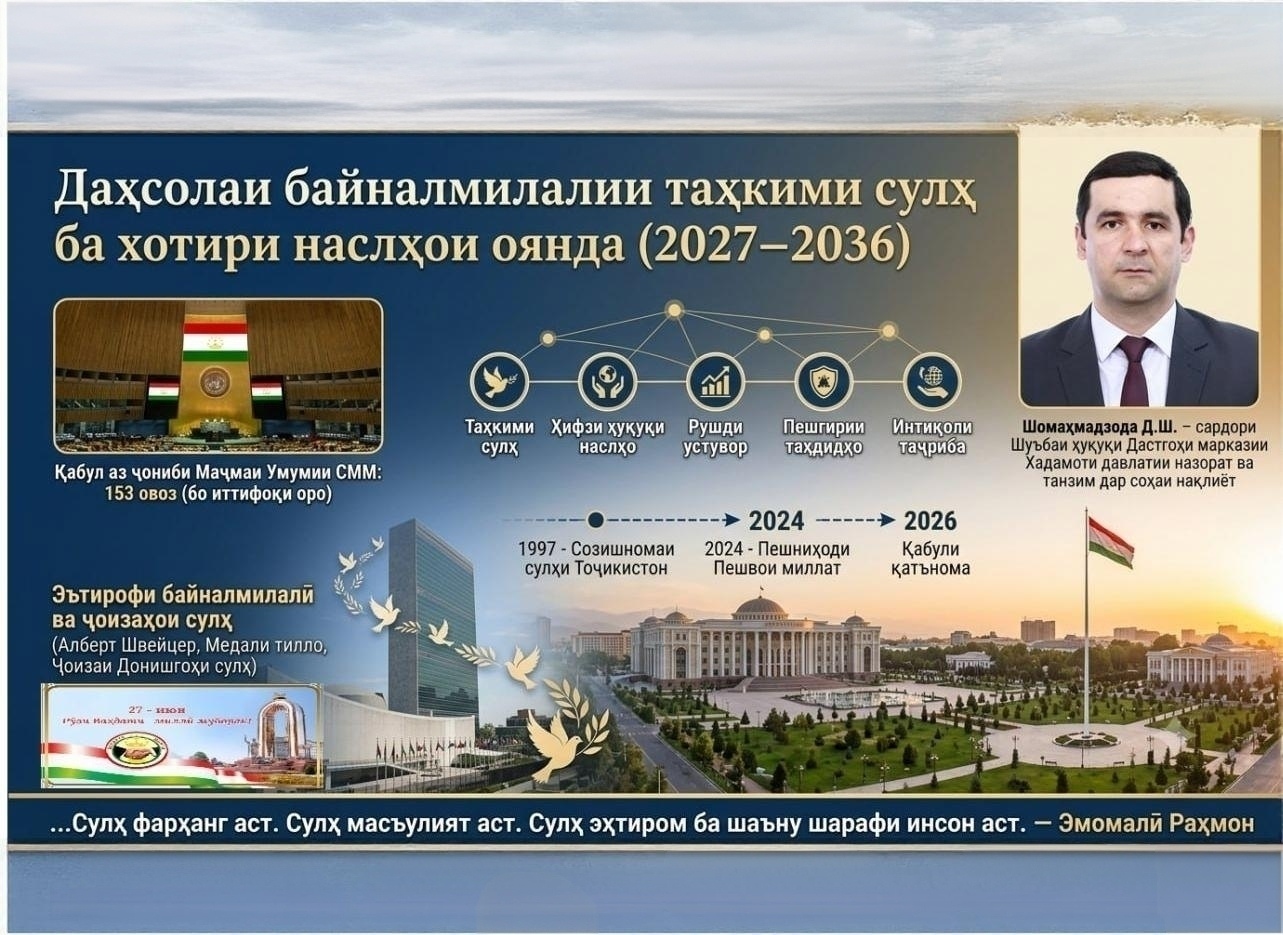
D. Sh. Shomakhmadzoda -Head of the Legal Department of the Central Office of the State Service on Control and Regulation in the Field of Transport in modern conditions, the system of international relations is facing profound geopolitical changes, the growth of armed conflicts, transnational threats, terrorism, extremism, humanitarian crises and competition from world powers. Today, more than 120 devastating armed conflicts are taking place in the corners of the world, undermining the values of sustainable peace. In such a delicate situation, the search for new ways to ensure security has become a central issue in the science of international law.On June 25, 2026, at the initiative of the Republic of Tajikistan, the United Nations General Assembly (UN) adopted the resolution “International Decade for the Consolidation of Peace for Future Generations (2027-2036)” with the Union of ORO (out of 154 states, 153 countries). This historic event was a great victory for Tajikistan’s diplomacy and demonstrated the unique solidarity of the international community. This step is a logical continuation of the consistent efforts of the Founder of Peace and National Unity, the Leader of the Nation, the President of the Republic of Tajikistan, the respected Emomali Rahmon, whose proposal was put forward in September 2024 at the 79th session of the UN General Assembly.From the point of view of jurisprudence, this document interprets peace not only as “the absence of war”, but also as an institutional process of creating decent living conditions for future generations. Legal significance of the act: this resolution in the system of international law has the character of “soft law”. However, its normative value is very high, as such documents perform an important formative function of international legal opinion and form the basis for the creation of generally binding norms.The resolution specifically recognizes the declaration and program of action on a culture of peace, linking the concept of peace with tolerance and solidarity between generations. In addition, the greeting of the “future pact” (2024) is a reference to strengthening the responsibility of States towards the future. The preamble of the act reflects the UN Charter’s call to “save future generations from the scourge of war,” which makes State sovereignty compatible with common interests in the light of the rights of future generations. In the early years of independence, Tajikistan felt the devastating effects of the imposed civil war in its flesh and skin. Our country has suffered more than 150,000 human casualties and more than $10 billion in economic damage in this tragedy, faced with a threat to the existence of the state. It was thanks to the reconciliation of the Institute of National Reconciliation, which was founded at the 16th session of the Supreme Council, that a unique model of post-conflict governance was formed. The peace of the Tajiks, achieved by signing the “general agreement on the establishment of peace and national accord” (June 27, 1997 in Moscow), ended with a peaceful conclusion within 1,171 days. The universal feature of the “Tajik peace formula” is that it was secured not by the victory of one of the parties, but on the basis of compromise and dialogue. Former UN Secretary-General Kofi Annan stressed: “Tajikistan’s peace experience deserves a comprehensive study.”Today, Tajikistan’s national peacekeeping experience is internationally recognized and validated as a source of inspiration for other conflicting regions.
Meanwhile, the new resolution welcomes the efforts of Tajikistan, Kyrgyzstan and Uzbekistan to resolve border issues diplomatically, which is a successful example of preventive diplomacy in Central Asia.The most important innovation of this resolution is that it transforms the principle of “interethnic responsibility” from an ethical concept into a legally political commitment to peace. This responsibility consists of three components:1. Positive Responsibility: States should not only refrain from war, but also actively work to build a culture of peace.2. Procedural responsibility: inclusiveness of decision-making processes involving youth, children and the elderly to ensure the interests of generations.3. Final responsibility: ensuring the well-being of future generations as the ultimate goal of public policy.The Decade aims to unite the efforts of the world community in the following areas: Strengthening peace and trust: creating a favorable atmosphere for dialogue. Conflict prevention is more effective from both an economic and humanitarian point of view than restoring peace after a war.Protecting the rights of future generations: ensuring their right to live in a peaceful and secure world based on the UN Charter.Sustainable development and its connection to peace: contributing to the realization of the Sustainable Development Goals (SDGs), since economic growth is impossible without peace.Preventing transnational threats and security: combating terrorism, extremism and climate change.Strengthening the role of the UN: Bringing society out of the state and hopelessness of the current Middle East and Ukrainian crises to the realization of the need for collective cooperation, the merits of respected Emomali Rahmon have been highly appreciated internationally. They are the first world politician to be awarded the Albert Schweitzer Gold Star and the gold medal “For Strengthening Peace and Harmony among Peoples” (2005).The latest example of this recognition is the presentation on May 25, 2026 of the award-the certificate of the UN University of Peace to the Leader of the nation for his outstanding contribution to the establishment of peace, the development of regional cooperation and the signing of historic border agreements. Today, the head of our state is recognized among the ranks of outstanding peace-loving figures of the world, such as Mahatma Gandhi, Martin Luther King and Nelson Mandela.The President of the Republic of Tajikistan has announced that a major international conference dedicated to the 30th anniversary of National Unity Day and the official start of the decade will be held in Dushanbe in 2027. The following proposals are being put forward for the successful implementation of this initiative:1. At the national level: development of a national concept for the implementation of the Decade of Peace, reflecting the legal, educational and social aspects of interracial responsibility and the legal education of citizens in the spirit of peacefulness.2. At the regional level: the establishment of a regional center for the study of the culture of peace in the city of Dushanbe in order to study Tajikistan’s experience in the peaceful resolution of border disputes as a model for developing countries.3. At the scientific level: within the framework of the 2027 International Conference in Dushanbe, to develop and present the “Dushanbe Declaration on the Right of Future Generations to Peace”, which will become a new stage in the development of the science of international law.The leader of the nation, respected Emomali Rahmon, commented on the deep essence of this step: “First of all, we must teach teenagers and youth, who are the creators of tomorrow’s peace, that peace is not only the absence of war. The world is a culture. Peace is a responsibility. Peace is about respect for human dignity…
The fate of future generations depends on the decisions we make today.”Tajikistan’s initiative shows that preventing war is better than treating its consequences. This decade is a global challenge and a successful model of peace diplomacy in the 21st century to leave a peaceful space for future generations.Long live peace, peaceful coexistence and lasting integration for future generations!.
