

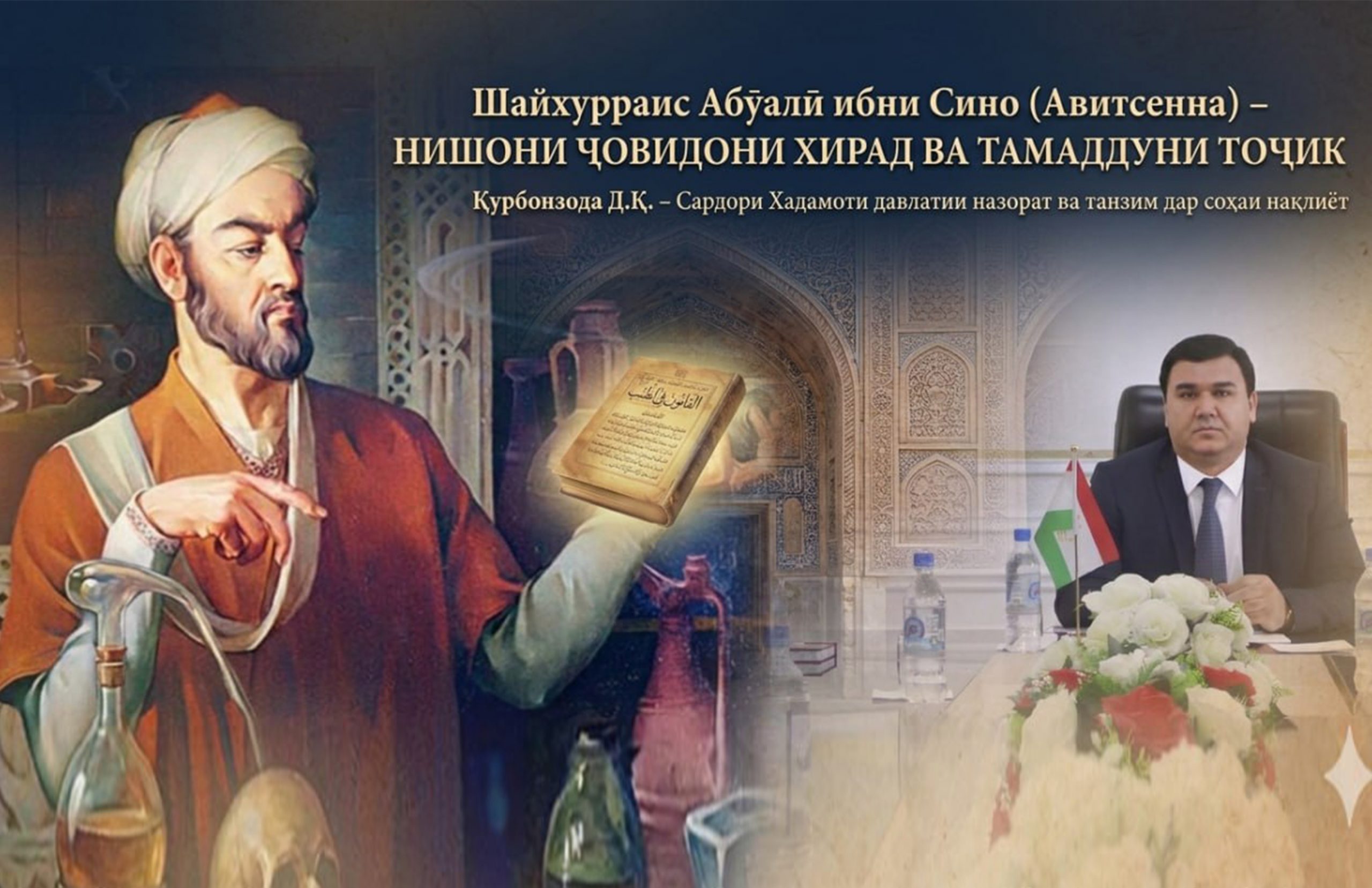
Kurbanzoda D.K
Head of the State Service on Control and Regulation in the Field of Transport
In the history of human civilization, there are bright stars that have illuminated the path of humanity for centuries with their light of ingenuity. One of these unique geniuses is the eternal Tajik-Persian thinker, philosopher, physician and scientist Sheikhurrais Abu Ali ibn Sina (Avicenna). This great role that this hypothetical man has played in the cultural history of our nation and humanity has perpetuated his name.
As the founder of peace and national unity, Leader of the Nation, President of the Republic of Tajikistan, dear Emomali Rahmon, noted in his valuable book “Monumental faces”: “Sheikhurrais Abuali ibn Sina is one of the greatest Tajik–Persian philosophers, scientists, doctors and writers who made an outstanding contribution to the development and improvement of world civilization… Thanks to his eternal creativity, Ibn Sina remains on the same level with humanity today.”
Abu Ali ibn Sina (August 18, 980 – June 22, 1037) lived and worked during the reign of the Samanids, the first centralized Tajik state. He was born in the village of Afshana near Bukhara. His father Abdullah came from the Persian-speaking population of Balkh, and his mother Sitar came from the village of Afshana, which is convincing evidence of his Tajik ethnic origin.
The Samanid era was a period when the Tajik people were forming as an ethnocultural group, and Dari-Persian was the main language of science and literature. Ibn Sina wrote his works both in Arabic (the scientific language of that era) and in his native language, Dari Farsi, and made a unique contribution to the development of both languages.
Ibn Sina was a natural genius. He studied the Quran and literature at the age of 10, and at the age of 17 he became famous as a mature scholar and attending physician. After the rescue of the Samanid Emir Noah ibn Mansur from a serious illness, he was allowed to use the famous Samanid library, and he improved his knowledge.
Despite the fact that the end of Alim’s life came after the fall of the Samanids in Farsirat and the persecution of the emirs, he left more than 250 (according to some sources, more than 400) works as a legacy. His key works, such as “Book-un-healing,” “book-un-salvation,” “encyclopedia,” and “Pointers and Reprimands,” cover the comprehensive worldview of the time.
Ibn Sina’s greatest and most famous medical work is Al-Lah fi-t-tib (the law of Medical science). This book, consisting of 5 volumes, represents not only the experience of the sage himself, but also a summary of the achievements of medicine in Greece and Rome, India and China, Iran and Central Asia.
For the first time in the history of medicine, Ibn Sina predicted the existence of microbes and insects invisible to the naked eye, and introduced the diagnosis of diabetes mellitus (diabetes mellitus) and the method of finger percussion (percussion). He also prioritized environmental sanitation and the use of boiled water to prevent cholera and Typhus.
The book was translated into Latin in the 12th century and has served as the main guide to medical education in all European universities for over 500 years. According to historians, there are few books in the history of civilization that, like Al-Zakan, have served the whole world impartially for almost a thousand years, regardless of nationality, religion or race.
Today, Ibn Sina is a source of national pride for the Tajik people and a symbol of the scientific and cultural power of our ancestors in the Middle Ages. At the same time, he was one of the greatest people who ever lived on earth. His name is given to the Tajik State Medical University, districts, squares and cultural institutions. His majestic statue in the center of the capital, Dushanbe, is the epitome of the wisdom and ingenuity of the Tajik people.
The great German scholar Burchard Brentes estimated: “The Tajiks, using the example of Ibn Sina, embodied the high culture of the peoples of Central Asia. Today they preserve the legacy of Ibn Sina mu. Conclusion, the legacy of Abu Ali Ibn Sina is for us not only a golden page of history, but also a real guide on the path of national self-awareness, the development of science and the upbringing of the younger generation in the spirit of patriotism and wisdom.
