
Mudinzoda S.M. –
Head of the Human Resources and Special Operations Department
State Services on Control and Regulation in the field of transport
The modern era is a period of severe trials and profound geopolitical changes for humanity. Today, the world community is facing an increase in armed conflicts, transnational threats, terrorism, extremism, and humanitarian crises. According to experts and research institutes, there are more than 100-120 devastating armed conflicts in all corners of the world that undermine the values of sustainable peace. In such sensitive conditions, the search for new ways to ensure international security and prevent wars has become the central problem of the world community.
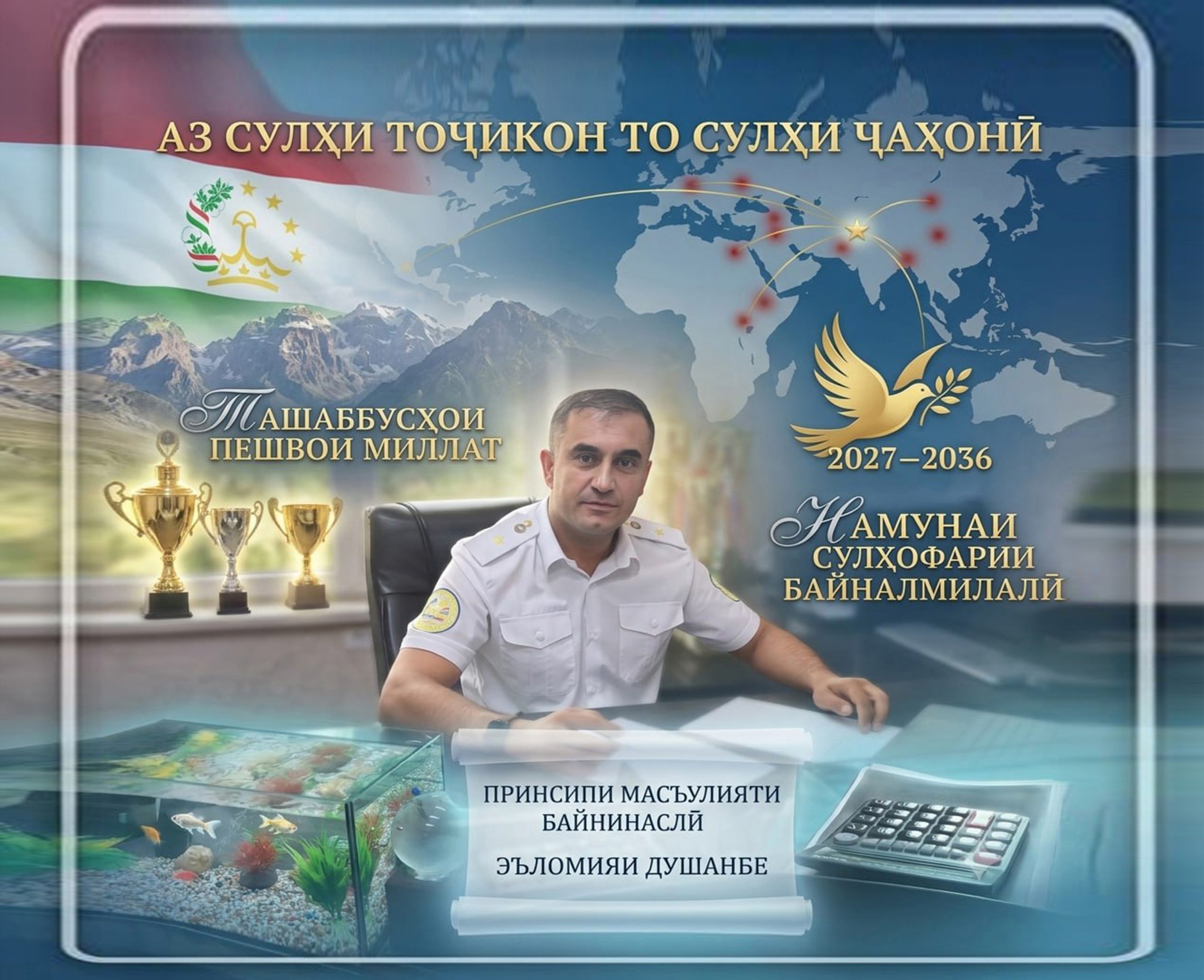
In this context, the adoption of the UN General Assembly resolution of June 25, 2026 entitled “International Decade for the Consolidation of Peace for Future Generations, 2027-2036” represents a qualitatively new and relevant turn in world politics. This document, proposed at the initiative of the Founder of Peace and National Unity, the Leader of the Nation, the President of the Republic of Tajikistan, the respected Emomali Rahmon, was warmly welcomed by the international community and ratified by the kingdoms of the partner countries and 153 relevant votes (out of 154 States).
This global and strategic initiative is based on the experience of peace-building and unity of the Tajik people. In the early years of its independence, the Republic of Tajikistan experienced an imposed civil war and faced a threat to its State existence. The tragedy resulted in the deaths of 150,000 civilians and economic damage amounting to more than 10 billion US dollars.
But it was thanks to the firm political will and extraordinary wisdom of the nation’s Leader, the respected Emomali Rahmon, who swore an oath of peace at the 16th session of the Supreme Council, that the process of national reconciliation began. Lengthy peace negotiations (1994-1997) in Moscow, Geneva, Almaty and Tehran ended on June 27, 1997 with the signing of the “general agreement on the establishment of peace and national accord in Tajikistan.”
The universal feature of the Tajik world is that it was achieved not as a result of one side’s victory over the other, but on the basis of compromise, mutual concessions and constructive dialogue. Former UN Secretary-General Kofi Annan stressed that “the experience of peace in Tajikistan deserves a comprehensive study,” as this complex conflict ended in a peaceful settlement in the shortest possible time – 1,171 days. Today, this practice is recognized and widespread internationally as a “unique model of peace-building.”
The most important legal innovation of this resolution is that it transforms the principle of “interethnic responsibility” from a purely moral concept into a legal and political obligation in the peaceful sphere. Previously, the concept of responsibility to future generations was most often considered in the context of environmental law, but the new resolution introduced it into the sphere of international law of the world.
In this context, three constituent elements of interracial responsibility are established.:
1. Positive Responsibility: States should not only refrain from war, but also actively work to build a culture of peace.
2. Process responsibility: involving youth and children in decision-making processes that ensure future interests are taken into account.
3. Final responsibility: ensuring the well-being of future generations as the ultimate goal of public policy.
The leader of the nation, Emomali Rahmon, explained this point in great detail in his congratulatory message: “First of all, we must teach teenagers and young people who are the creators of tomorrow’s peace that peace is not only the absence of war. The world is a culture. Peace is a responsibility. Peace is about respect for human dignity.”
Today, Tajikistan has moved from the position of a consumer of peace to the position of an initiator of international peace. The country’s foreign policy, enshrined in article 11 of the Constitution as peacemaking, plays an outstanding role in the peaceful resolution of regional disputes. In particular, the signing of historic border agreements between Tajikistan, Kyrgyzstan and Uzbekistan through diplomatic channels is a prime example of preventive diplomacy in Central Asia, which has also been officially recognized and evaluated by the UN University for Peace.
In addition, Tajikistan constantly links issues of water, climate and environmental security with lasting peace, as the lack of natural resources can become the ground for new conflicts. Peace is the main condition for the implementation of the UN Sustainable Development Goals, including Goal 16 (peace, justice and strong institutions), because economic and social progress is impossible without it.
Adoption of the resolution “International Decade for the Consolidation of Peace for Future Generations (2027-2036)”It is a historic victory for Tajikistan’s diplomacy and international recognition of the merits of the leader of the nation, which puts his name among the outstanding world peacemakers such as Mahatma Gandhi and Nelson Mandela.
In order to put this great initiative into practice, a high-level international conference dedicated to the 30th anniversary of National Unity Day and the official beginning of the decade will be held in Dushanbe in 2027. For effective use of this platform, it is proposed:
1. Develop and implement a National Concept for the implementation of the Decade of Peace at the national level.
2. The mechanisms of preventive diplomacy of Tajikistan will be explored through the establishment of a regional center for the study of the culture of peace in Dushanbe.
3. Within the framework of the 2027 conference, develop and submit to the international community the draft “Dushanbe Declaration on the Right of Future Generations to Peace.”
Peace is a prosperous legacy that we must preserve for future generations, and along the way, the peaceful policy of the nation’s leader will be our main guide.
